
Running demanding games at high resolution can expose the limits of an older graphics card quickly. Frame rates may become inconsistent, newer visual effects can require compromises, and 4K gaming often brings a difficult choice between image quality and smoothness. The GIGABYTE Radeon RX 9070 XT Gaming OC 16G is built for buyers who want a powerful desktop GPU with 16GB of dedicated memory, modern display connections, and enough headroom for demanding gaming and creative workloads.

This GIGABYTE graphics card review looks at the exact GV-R9070XTGAMING OC-16GD model, including its verified specifications, practical advantages, setup requirements, and the situations where a less demanding or more compact card may make better sense.
This article may contain affiliate links to Amazon and AliExpress. If you purchase through one of these links, I may earn a commission at no extra cost to you.
GIGABYTE Graphics Card Overview and Buying Context
Common problems and the product’s solution
A few problems regularly affect buyers shopping for a high-performance GPU.
The first is limited video memory. Modern games, high-resolution textures, ray-traced effects, and multitasking can all increase memory demand. This card includes 16GB of GDDR6 memory on a 256-bit interface, giving it a substantial dedicated memory pool for demanding graphics workloads.
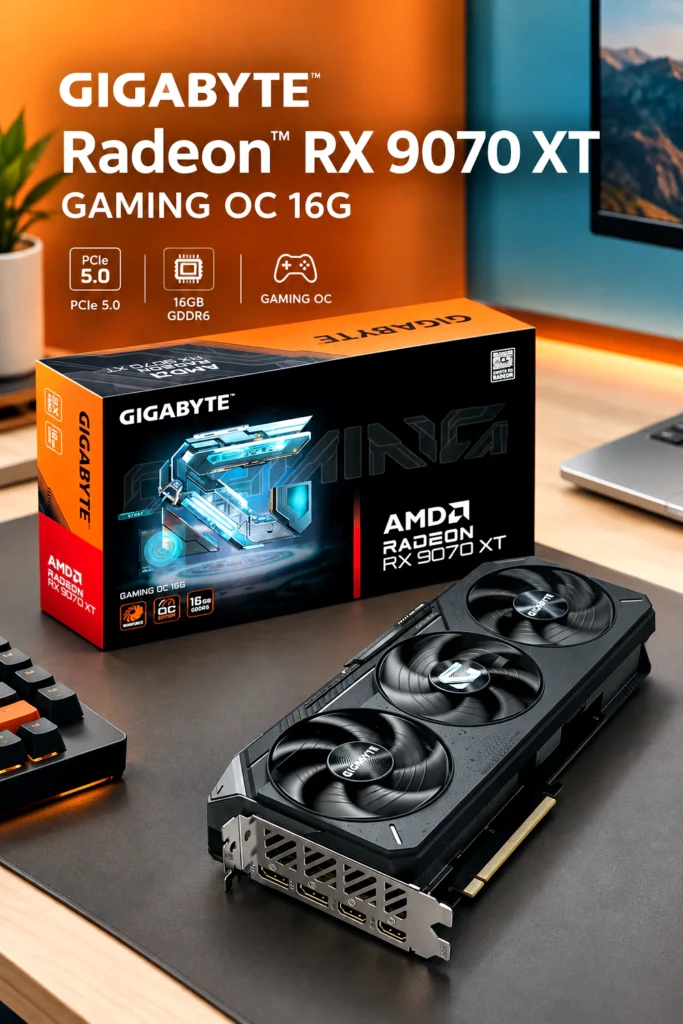


The second is display flexibility. A card may be powerful enough for several monitors but lack the right ports for a particular setup. This model provides two DisplayPort 2.1a outputs and two HDMI 2.1b outputs, with support for up to four displays according to the product specifications.
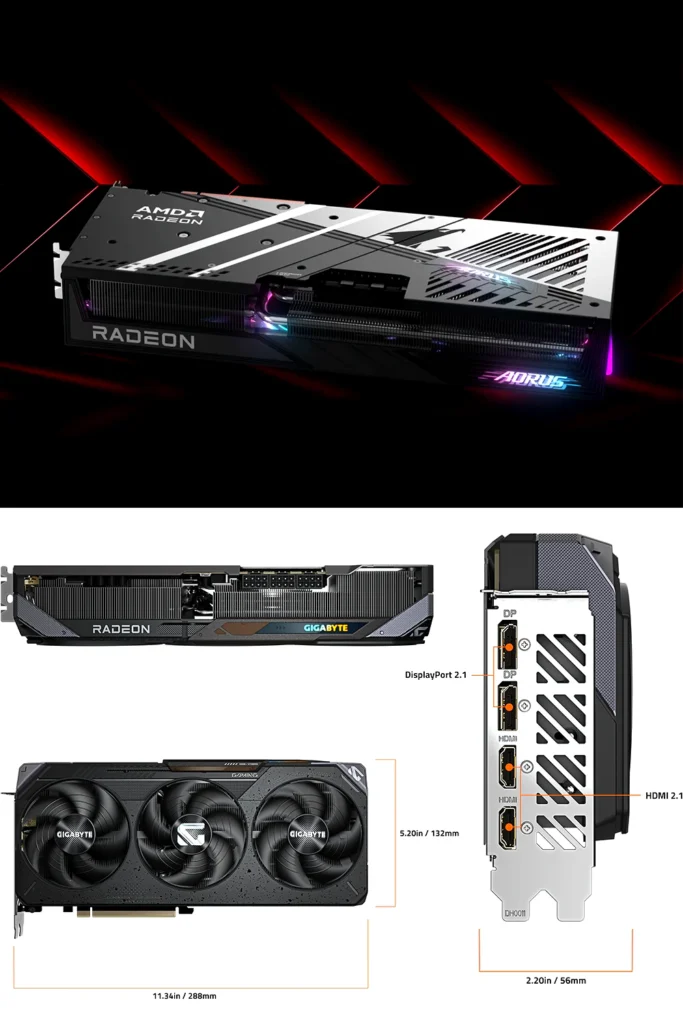
The third issue is system compatibility. High-end GPUs are not simply drop-in upgrades for every desktop. This model measures 288 × 132 × 56 mm, uses three 8-pin power connectors, and has an 850W recommended power supply. Those requirements make case clearance, PSU capacity, and available power cables important pre-purchase checks.
Product overview
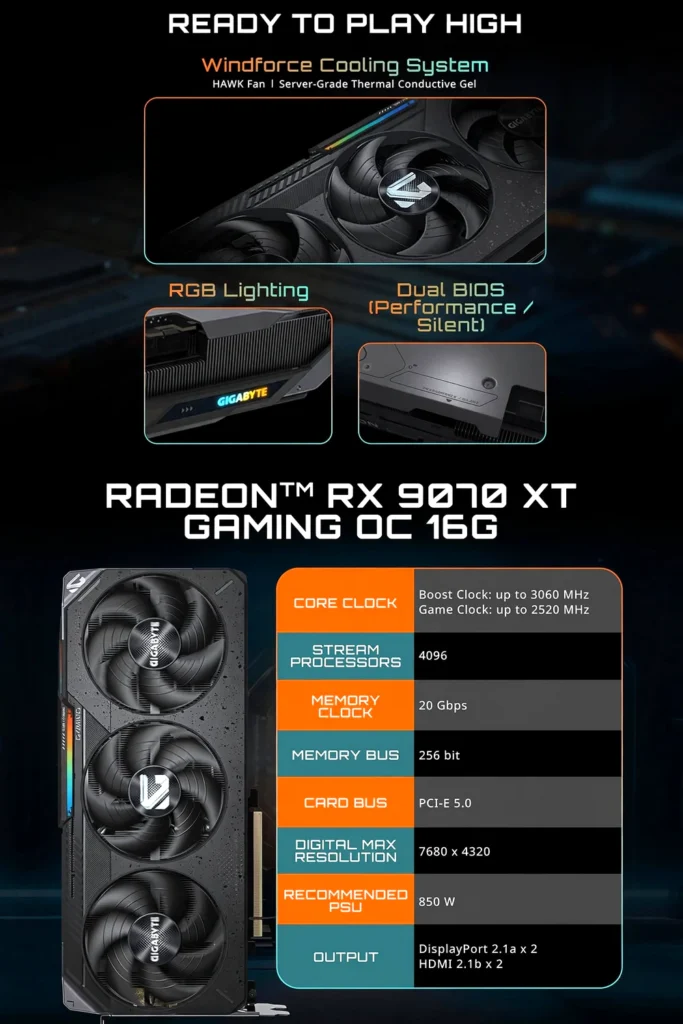
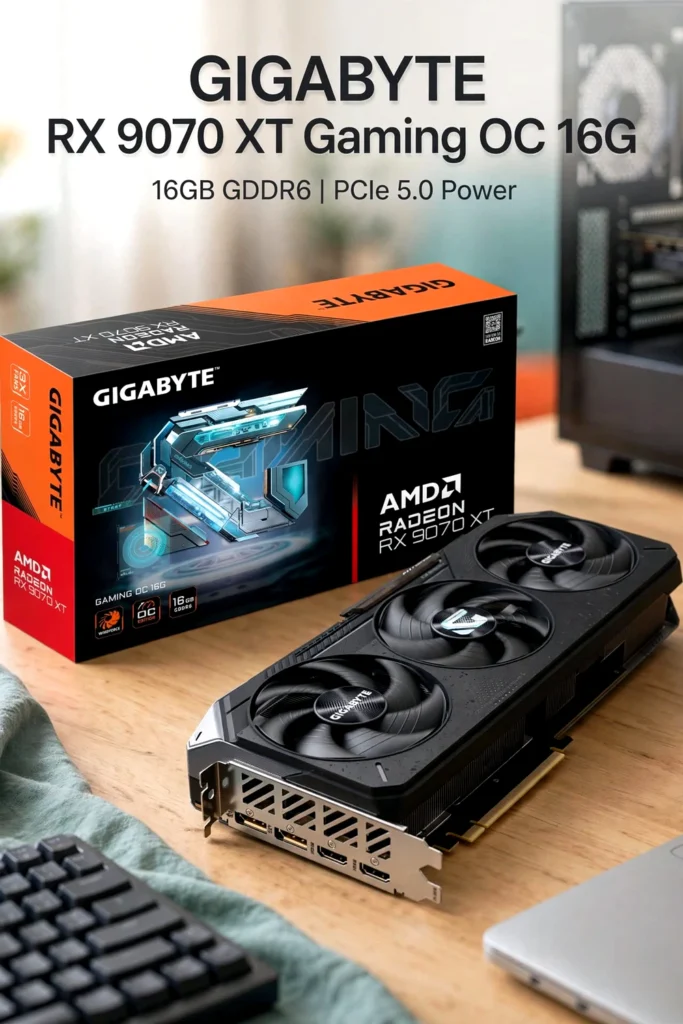
The GIGABYTE Radeon RX 9070 XT Gaming OC 16G is a desktop graphics card based on AMD’s Radeon RX 9070 XT GPU. It uses PCIe 5.0, 16GB of GDDR6 memory, and GIGABYTE’s factory-overclocked Gaming OC configuration.
GIGABYTE lists a boost clock of up to 3060 MHz and a game clock of up to 2520 MHz. The reference RX 9070 XT figures are lower, at up to 2970 MHz boost and 2400 MHz game clock. These are maximum or expected clock figures rather than guaranteed speeds in every game; actual results vary with workload, temperature, and the rest of the system.
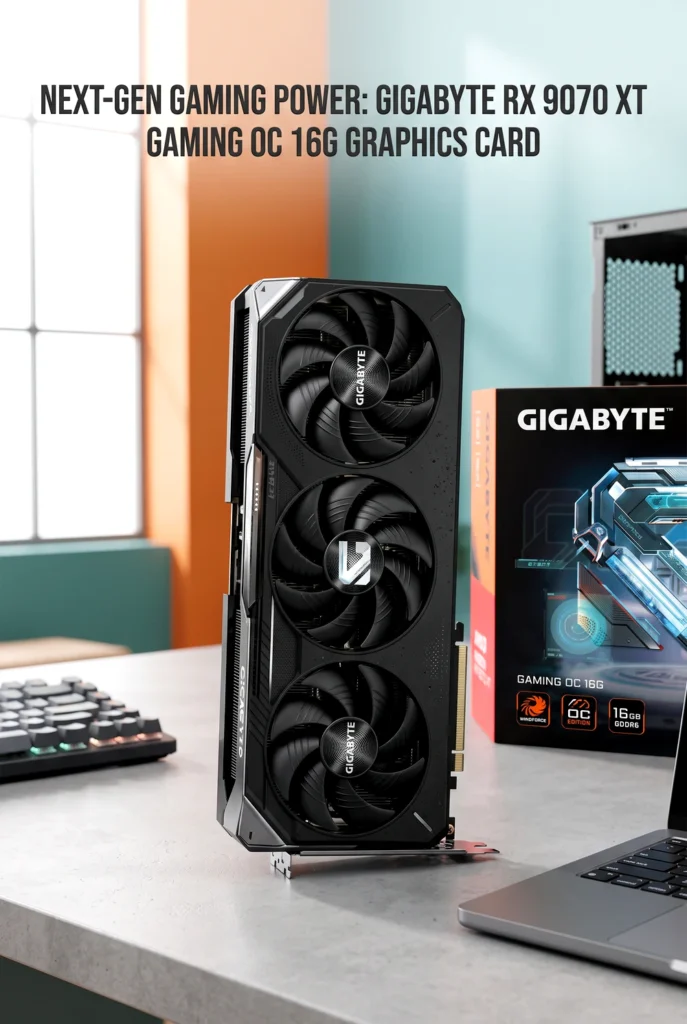
The card is aimed primarily at serious PC gamers who want high-resolution performance without immediately moving to an enthusiast-tier solution. It may also suit users who work with GPU-accelerated creative software, multiple displays, or video formats supported by the Radeon platform. Performance still depends on the processor, motherboard, drivers, game settings, and monitor, so the graphics card should not be evaluated in isolation.
Key features that matter
16GB of GDDR6 memory
The 16GB memory capacity is one of the most practical features here. It gives demanding games and applications more room for textures, frame buffers, and other graphics data than lower-capacity cards.
That does not guarantee a particular frame rate, and memory capacity alone does not determine overall GPU performance. Still, 16GB is useful for buyers who plan to keep the card for several years, play at 1440p or 4K, or use large texture packs.
The trade-off is that buyers paying for this level of memory should also have a monitor and system capable of benefiting from the card. For a basic 1080p gaming computer, this may be more graphics power than necessary.
Factory-overclocked clock speeds
The Gaming OC version lists up to 3060 MHz boost and up to 2520 MHz game clock. In theory, higher clock targets can help the card deliver more performance than a reference-clocked design, but the actual difference depends on the workload and thermal conditions.
GIGABYTE’s own specification notes that boost clock achievability, frequency, and sustainability vary. That is important context: these numbers are not a promise that every game will run continuously at 3060 MHz.
PCIe 5.0 x16 interface
PCIe 5.0 provides a current-generation connection between the card and a compatible motherboard. The card can also be considered by owners of older PCIe platforms, although the exact behavior and available bandwidth depend on the system.
For most buyers, PCIe 5.0 is more about platform readiness than an immediate guarantee of better in-game performance. The GPU’s processing capability, memory subsystem, drivers, and game engine remain major factors.
Modern video outputs
The card includes two DisplayPort 2.1a connections and two HDMI 2.1b connections. This is a flexible arrangement for gaming monitors, high-resolution displays, televisions, and multi-monitor workstations.
GIGABYTE lists a maximum digital resolution of 7680 × 4320 and support for up to four displays. Those figures describe supported output capability, not a guarantee of smooth gaming at that resolution. Refresh rate, cable quality, software support, and the game itself still matter.
AMD graphics features
The underlying Radeon RX 9070 XT platform supports features such as hardware ray accelerators, AI accelerators, AV1 encoding and decoding, AMD FreeSync technology, Radeon Super Resolution, and other software-based features. Their usefulness depends on the application and whether the developer or software platform supports them.
For streamers and video creators, AV1 encode support may be relevant. For gamers, features such as upscaling, frame generation, or latency tools can change the experience, but they should be treated as workload-dependent tools rather than guaranteed improvements in every title.
Design, materials, and build
The verified specification identifies this as an ATX graphics card measuring 288 mm long, 132 mm wide, and 56 mm high. That makes it a substantial component rather than a compact upgrade.
The 56 mm height and listed three-slot form factor reported by third-party specification information mean buyers should pay close attention to neighboring expansion slots, case width, and airflow. The product information confirms the dimensions and power connectors, but it does not by itself establish long-term durability, noise levels, or cooling performance.
The card requires three 8-pin power connectors, while GIGABYTE recommends an 850W power supply. That is a meaningful consideration for anyone upgrading from a lower-power GPU. Check not only the PSU’s advertised wattage but also whether it has the required dedicated connectors and whether the case can accommodate the card without obstructing other components.
Real-world use
This card is best suited to a permanent desktop gaming or workstation setup. Its size and power requirements make it less attractive for compact cases, small-form-factor systems, or buyers who move their PC frequently.
For a home gaming system, the combination of 16GB memory and multiple modern display outputs provides room for high-resolution gaming and multi-monitor use. For a work-from-home setup, the four display outputs may be useful for a wide desktop, but the card’s size and power draw could be excessive if the main requirement is simply office productivity.
The quick guide is listed as an included accessory. Other accessories should be confirmed on the current listing before purchase rather than assumed.
Buying Decision for the GIGABYTE Radeon RX 9070 XT
How it compares with typical alternatives
Compared with a simpler midrange graphics card, this model offers more memory, higher processing capability, and a stronger feature set for high-resolution gaming. The trade-off is a larger physical footprint, higher power requirements, and potentially higher system cost.
Compared with a reference-style or lower-clocked version of the same GPU, the Gaming OC variant lists higher clock targets. That may appeal to buyers who want a factory-tuned model without manually overclocking. The practical gain will vary, however, and it should not be treated as a completely different performance class.
A smaller or lower-power card may be easier to install and more appropriate for a modest gaming PC. It may also cost less to operate and place fewer demands on the power supply. The compromise is usually less memory headroom and less suitability for demanding high-resolution settings.
Pros and cons
Pros
- 16GB of GDDR6 memory with a 256-bit interface.
- Boost clock listed at up to 3060 MHz.
- PCIe 5.0 x16 interface.
- Two DisplayPort 2.1a and two HDMI 2.1b outputs.
- Support for up to four displays.
- AV1 encoding and decoding support through the Radeon RX 9070 XT platform.
- Suitable on paper for demanding 1440p and 4K-oriented systems.
Cons
- The 288 mm length and 56 mm height require careful case planning.
- Three 8-pin power connectors may complicate upgrades in older systems.
- GIGABYTE recommends an 850W power supply.
- Advertised boost and game clocks vary with workload and thermal conditions.
- A powerful card may be unnecessary for basic 1080p gaming or office use.
- Noise, temperatures, warranty terms, and long-term reliability should be confirmed separately for the exact seller and region.
Who should buy it
This card makes the most sense for a desktop gamer building or upgrading a performance-focused system. It is especially relevant if you want:
- A large 16GB memory buffer.
- High-resolution gaming capability.
- Modern DisplayPort and HDMI connectivity.
- Support for several monitors.
- A factory-overclocked version of the Radeon RX 9070 XT.
- A card that can also support GPU-accelerated creative or video workloads.
It may also fit buyers who prefer keeping a graphics card for several upgrade cycles and want more memory headroom than entry-level or mainstream models commonly provide.
Who may want something else
A different card may be better if your case cannot comfortably fit a 288 mm, 56 mm-high GPU. The same applies if your power supply lacks three 8-pin connectors or falls well below the recommended 850W capacity.
You may also want a simpler option if you mainly play older or lightweight games at 1080p. In that situation, the extra capacity and physical size may not deliver enough practical value to justify the larger upgrade.
Buyers focused primarily on professional software should verify application-specific support before choosing a Radeon card. Hardware specifications are useful, but software compatibility and acceleration support can matter just as much.
Buying considerations
Before ordering, confirm the following:
- Your case supports 288 × 132 × 56 mm, with enough room around adjacent expansion slots.
- Your motherboard and operating system support the intended configuration.
- Your power supply is suitable for the card and has three required 8-pin connectors.
- Your monitor cables match the DisplayPort or HDMI connection you plan to use.
- Your preferred games or creative applications support the Radeon features you expect to use.
- The current listing includes the warranty, accessories, shipping terms, taxes, and regional support you need.
Pricing, availability, promotions, taxes, and shipping can change, particularly for graphics cards. Check those details at checkout rather than relying on an earlier listing.
Is it worth the price?
The feature set may justify a premium for buyers who need 16GB of memory, modern display outputs, and a factory-overclocked RX 9070 XT configuration. It is harder to justify for someone upgrading a basic gaming system where a lower-power GPU would already meet the monitor’s resolution and refresh-rate needs.
Value depends heavily on the current selling price and the rest of your build. A powerful graphics card can become a poor purchase if it forces an expensive power-supply or case upgrade that was not part of the original budget.
Final verdict
The GIGABYTE Radeon RX 9070 XT Gaming OC 16G is a serious desktop GPU with a strong specification sheet: 16GB of GDDR6 memory, PCIe 5.0, modern video outputs, and higher listed clock targets than the reference RX 9070 XT. Those features make it a sensible candidate for demanding gaming and multi-display systems.
Its main limitation is practical rather than unusual for this class of product. The card is large, uses three 8-pin connectors, and comes with an 850W recommended PSU requirement. Buyers should also remember that boost-clock figures do not guarantee identical performance in every workload.
If your case, power supply, monitor, and budget match the card’s requirements, this GIGABYTE graphics card may be worth a closer look. Check the current listing for the latest price, availability, exact included items, specifications, and customer feedback before deciding.

The author of RigRamp.com has been managing and developing the website since 2015, with a strong background in online marketing and affiliate programs across various marketplaces. With a passion for technology, the author enjoys exploring the latest tech products, discovering useful digital tools, and following trends in the online industry.
