
Most gaming cases are designed to sit under a desk and disappear, or to sit on top of it and scream “gaming rig” with RGB and sharp angles. If you want a build that actually looks at home in a living room or a shared office, that leaves a pretty short list of options — which is exactly the gap a Fractal Design North PC case is built to fill. If you’re weighing whether a wood-front, glass-side ATX case is worth the extra design attention, the specs here answer most of the practical questions.
The Usual Problems With Cases Like This — and How North Handles Them
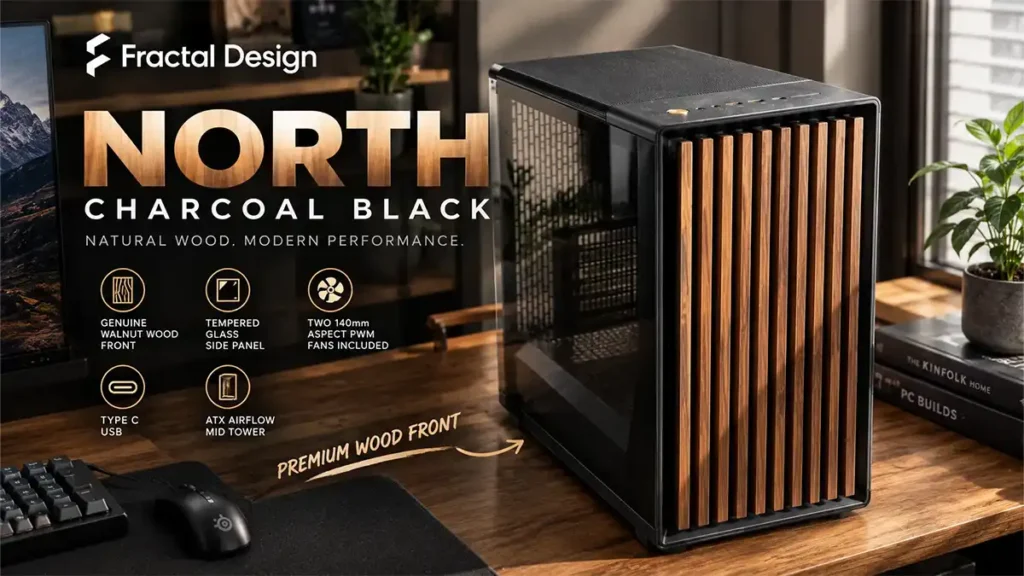


A few recurring complaints come up with stylish, wood-accented cases: not enough airflow because the front is closed off for looks, limited space for a real GPU or radiator once the aesthetic parts are in place, and drive/cable management that gets sacrificed for a clean look. Fractal addresses the airflow concern directly — the front isn’t a sealed wood panel, it’s an open front design with the walnut acting as accent bars rather than a solid barrier, paired with a mesh top for additional ventilation. On GPU space, North supports cards up to 355 mm with the front fans mounted, or 300 mm if you’ve installed a 360 mm radiator up front, which covers the large majority of current graphics cards. And for drive management, it includes two dedicated 2.5-inch mounts plus two combined 2.5/3.5-inch trays, so storage doesn’t get an afterthought treatment despite the design focus.
What This Case Actually Is

This is a mid-tower ATX case supporting ATX, Micro-ATX, and Mini-ITX motherboards, built around Fractal’s “North” line, which pairs a charcoal black steel-and-glass frame with real walnut wood accents on the front. The left side panel is 3mm dark-tint tempered glass, while the right side is solid steel — a fairly standard setup that shows off the build on one side while keeping cable management hidden on the other. It ships with two 140mm Aspect PWM fans pre-installed in the front, so a basic airflow setup is included out of the box rather than something you need to buy separately.
Key Features Worth Knowing About
Real walnut wood front panel. This is the case’s signature feature, and it’s genuine wood rather than a wood-look decal or vinyl wrap. For anyone building a PC to live somewhere more visible than a closet — a living room, a bedroom, a shared workspace — that natural material is the main reason to consider this case over a standard steel-and-plastic option. The tradeoff is that wood grain and tone can vary slightly piece to piece, which is normal for a natural material but worth knowing if you’re expecting perfect uniformity.
Open front and mesh top for airflow. Rather than closing off the front entirely for looks, Fractal Design kept it open behind the wood accents and added a mesh top panel. That matters because closed-front cases with wood or acrylic panels are notorious for trapping heat, and this design is a direct attempt to avoid that problem while keeping the aesthetic.
Radiator and cooling support. The case supports up to a 360mm radiator in front, 240mm on top, and 120mm in the rear, with CPU cooler clearance up to 170mm (or 145mm if you’re using the included fan bracket). That’s enough headroom for most air coolers and a serious AIO liquid cooling setup, though anyone planning a large custom loop should double-check clearance against their specific radiator and fitting combination.
USB-C front connectivity. The front I/O includes a USB 3.1 Gen2 Type-C port along with two USB 3.0 ports, which is a meaningful convenience if your peripherals or accessories have already shifted to USB-C, and something older cases often lack.
Seven expansion slots. With seven bridgeless expansion slots, there’s flexibility for multi-slot GPUs, additional PCIe cards, or a vertical GPU mount if you go that route, which isn’t guaranteed on every mid-tower case in this size class.
Real-World Use
For a home office setup, the wood front makes this a case you could reasonably place on top of a desk rather than tucking underneath it, and the mesh top and tempered glass side panel let you show off the build without a wall of RGB. As a fractal design north pc build for a living room entertainment setup, the natural materials genuinely stand out next to typical gaming hardware. It’s less suited to a competitive gaming setup focused purely on maximum airflow and cooling headroom, where a fully mesh front panel would outperform this more restrained open-front design.
How It Compares to Other ATX Cases
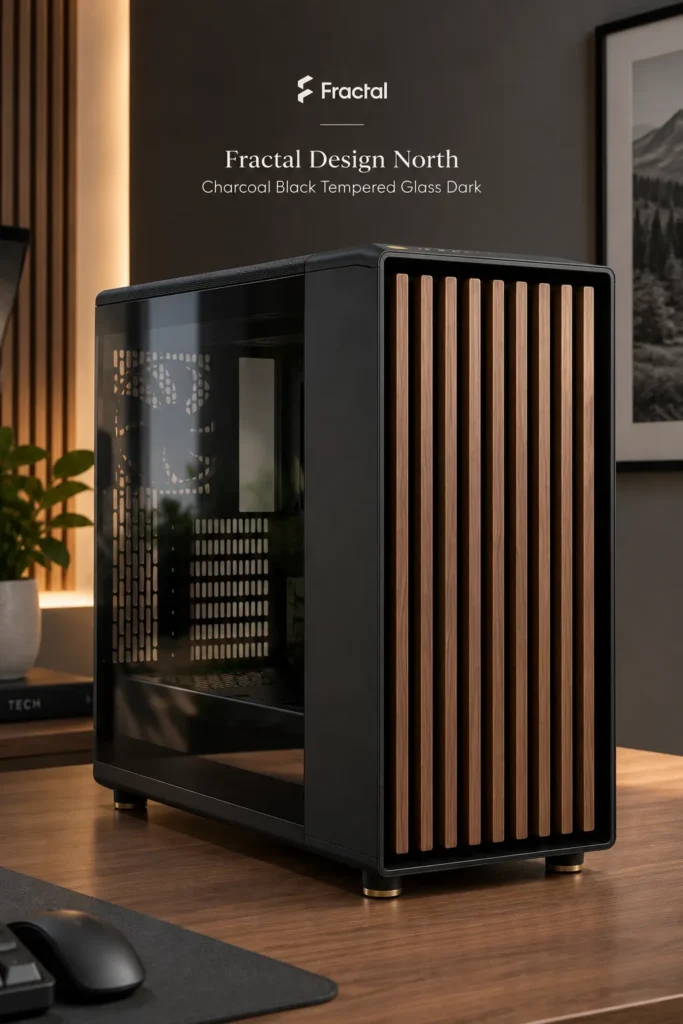
Against standard steel-and-glass ATX cases, North trades some raw front-panel airflow for a design that looks noticeably different from typical gaming aesthetics — most all-mesh cases will out-cool it under sustained heavy load, but few will match it visually on a desk or shelf. Compared to other “lifestyle” or wood-accented cases on the market, North’s advantage is that it doesn’t fully seal the front for looks — the open design and mesh top are a genuine attempt to avoid the ventilation compromise that a lot of style-focused cases make. If pure thermal performance under a heavy sustained workload is your top priority, a dedicated high-airflow mesh case will likely edge this one out.
Pros and Cons
Pros:
- Genuine walnut wood front panel for a distinct, natural look
- Open front design and mesh top help offset the airflow tradeoff of wood accents
- Supports GPUs up to 355mm and radiators up to 360mm in front
- USB-C front port plus two USB 3.0 ports
- Seven expansion slots for flexible builds
Cons:
- GPU clearance drops to 300mm if a 360mm front radiator is installed
- Natural wood grain will vary slightly between units
- Airflow, while better than fully closed wood-front cases, still won’t match a fully mesh case under max load
Who Should Buy This
Anyone building a fractal design north pc setup for a visible space — a living room, a bedroom, a shared office — where appearance matters as much as raw thermal performance will get the most out of this case. It also suits builders who want a genuine material front rather than a printed or vinyl wood look.
Who Might Want Something Else
If you’re chasing the lowest possible temperatures under sustained heavy load, or you’re building a case that will sit somewhere it won’t be seen, a fully mesh airflow case will likely perform better for less money. Builders planning an oversized custom water-cooling loop should also verify clearances carefully before committing to this case.
Buying Considerations
Before ordering, confirm your motherboard size (ATX, Micro-ATX, or Mini-ITX all fit) and measure your GPU length against the 355mm/300mm limits depending on whether you’ll run a front radiator. Check your CPU cooler height against the 170mm/145mm clearance figures, and if you’re mounting drives, note the two dedicated 2.5-inch slots plus two combined 2.5/3.5-inch trays. Budget-wise, expect to pay a premium over a standard steel-front ATX case, since the genuine wood material and design work add cost compared to a typical mesh-front alternative.
Is It Worth the Price?
For what it delivers — real wood materials, a tempered glass side panel, decent radiator and GPU clearance, and pre-installed fans — the case sits in a premium tier compared to basic ATX cases, and that price reflects the wood front panel and design work rather than just raw airflow performance. If a distinctive look for a visible build matters to you, that premium is reasonably justified. If your priority is squeezing out the best possible thermals for the lowest cost, you’d likely get more airflow per dollar from a simpler mesh-front case.
Final Verdict
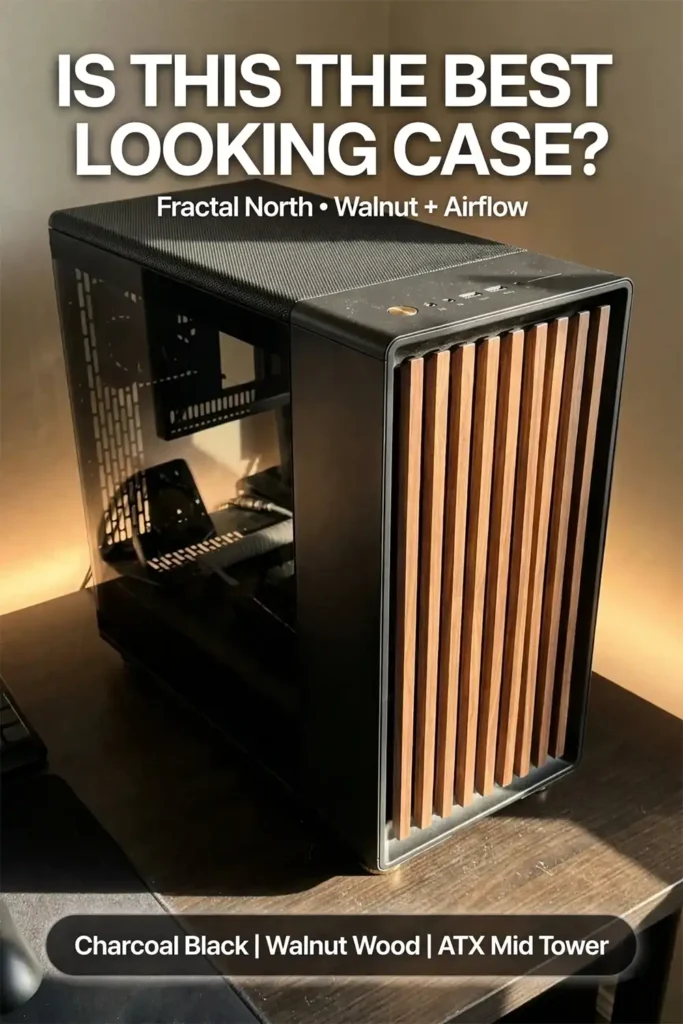
The Fractal Design North does what it sets out to do: it makes a gaming PC look like a piece of furniture rather than a gaming PC, without fully sacrificing airflow to get there. Its biggest limitation is that dedicated high-airflow cases will still out-cool it under sustained heavy loads, so it’s not the pick for someone chasing maximum thermal headroom above all else. For anyone building a rig meant to be seen — in a living room, an office, or anywhere else appearance carries real weight — this looks like a solid, well-thought-out option.
If you struggle with gaming cases that don’t fit anywhere outside a “gamer den” look, this is why I like this one — it’s one of the few builds that can sit in a living room without looking out of place. As always, double-check current pricing and availability on Amazon before buying, since both can shift over time.

The author of RigRamp.com has been managing and developing the website since 2015, with a strong background in online marketing and affiliate programs across various marketplaces. With a passion for technology, the author enjoys exploring the latest tech products, discovering useful digital tools, and following trends in the online industry.
